
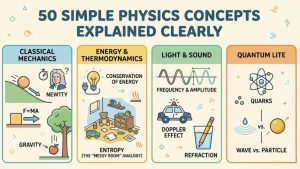
50 Simple Physics Concepts Explained Clearly

Physics often suffers from a branding problem—it uses intimidating words to describe very intuitive things. By using analogies, we can peel back the layers of jargon to reveal the simple logic underneath.

Here is a deep-dive glossary of 50 core concepts, categorized to help you master the fundamentals of the physical universe.


1. Classical Mechanics: The Rules of the Game

Classical mechanics describes how objects move. Think of this as the “instruction manual” for everything larger than an atom and slower than the speed of light.

  • Gravity: The universe’s “magnetic” pull. Every object with mass pulls on every other object.
  • Force: A push or a pull. Without force, nothing changes.
  • Inertia: The universe’s laziness. Objects want to keep doing exactly what they are already doing (staying still or moving).
  • Mass vs. Weight: Mass is how much “stuff” you are made of; weight is how hard gravity is pulling on that stuff. You have the same mass on the Moon, but you weigh much less.
  • Acceleration: Not just speeding up, but any change in velocity (speeding up, slowing down, or turning).
  • Centripetal Force: The “string” that keeps an object moving in a circle, like a tetherball or the Moon orbiting Earth.
  • Friction: The “tax” paid when two surfaces rub together, converting motion into heat.
  • Potential Energy: Stored energy, like a stretched rubber band or a ball at the top of a hill.
  • Kinetic Energy: The energy of motion.
  • Work: In physics, “work” only happens if a force moves an object. Pushing a wall until you sweat isn’t “work” because the wall didn’t move!

2. Energy & Thermodynamics: The Universal Budget

Thermodynamics is the study of heat and energy. It dictates what is possible in our universe.

  • Conservation of Energy: Energy cannot be created or destroyed; it only changes forms.
  • Entropy (The “Messy Room” Analogy): The universe naturally moves toward disorder. Just as a bedroom doesn’t spontaneously tidy itself, energy tends to spread out and become less useful over time.
  • Conduction: Heat transfer by touch (like a spoon getting hot in coffee).
  • Convection: Heat transfer through fluids (like hot air rising).
  • Radiation: Heat transfer through empty space (like sunlight).
  • Absolute Zero: The coldest possible temperature (0% Kelvin), where all molecular motion stops.
  • Thermal Expansion: Why bridges have gaps—materials expand when they get hot and molecules vibrate more.
  • Specific Heat: How much “effort” it takes to heat something up. Water has high specific heat, which is why the ocean stays cool even on a hot day.
  • The First Law: You can’t get something for nothing (Energy is conserved).
  • The Second Law: You can’t even break even (Entropy always increases).

Deep Dive: For a comprehensive look at the laws governing heat, check out the Laws of Thermodynamicsat Britannica.


3. Light & Sound: The Waves of Reality

Both light and sound travel as waves, but they play by different rules.

  • Frequency: How often a wave passes by. High frequency sounds like a whistle; low frequency sounds like a bass drum.
  • Amplitude: The “height” of the wave. In sound, this is volume; in light, this is brightness.
  • The Doppler Effect: Why a siren changes pitch as it passes you. Waves get “bunched up” as the source moves toward you and “stretched out” as it moves away.
  • Refraction: The “broken pencil” trick. Light slows down and bends when it moves from air into water.
  • Reflection: Light bouncing off a surface at the same angle it hit.
  • Diffraction: Waves bending around corners or squeezing through small gaps.
  • The Electromagnetic Spectrum: The full range of light, most of which we can’t see (X-rays, Microwaves, Radio).
  • Photons: Tiny “packets” of light energy.
  • Speed of Sound: Roughly 343 meters per second in air.
  • Speed of Light: The universal speed limit—roughly 300,000 kilometers per second.

4. Quantum Lite: The Weird Stuff

At the very smallest scale, the rules of classical mechanics break down completely.

  • Quarks: The “Legos” of the universe. They make up protons and neutrons.
  • Wave-Particle Duality: The idea that light and electrons act like both solid little balls (particles) and ripples in a pond (waves).
  • Superposition: An object existing in multiple states at once until someone looks at it (Schrödinger’s Cat).
  • Quantum Entanglement: “Spooky action at a distance.” Two particles becoming linked so that what happens to one instantly affects the other, no matter the distance.
  • Uncertainty Principle: The rule that you can’t know exactly where a particle is and how fast it’s going at the same time.
  • Standard Model: The “periodic table” for subatomic particles.

5. 10 Bonus Concepts to Round Out the 50

  1. Magnetism: Caused by the alignment of electron spins.
  2. Electricity: The flow of electrons through a conductor.
  3. Resistance: How much a material “fights” the flow of electricity.
  4. Buoyancy: The upward force that keeps boats afloat.
  5. Pressure: Force spread over an area.
  6. Density: How tightly packed the “stuff” in an object is.
  7. Plasma: The fourth state of matter—ionized gas found in stars and lightning.
  8. Surface Tension: The “skin” on top of water that lets bugs walk on it.
  9. Half-Life: The time it takes for half of a radioactive substance to decay.
  10. Relativity: The fact that time and space are linked and can stretch or shrink depending on speed and gravity.

Why does this matter?

Understanding these concepts doesn’t just make you better at trivia; it changes how you see the world especially in real life. When you look at a rainbow, you aren’t just seeing colors—you’re seeing the dispersion of light. When you feel the pull of a car turn, you’re experiencing inertia. You aren’t just living in the world; you are part of a giant, logical, physical machine.…
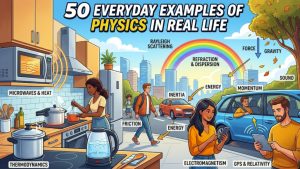
50 Everyday Examples of Physics in Real Life

Physics is often tucked away in heavy textbooks and complex equations, but it isn’t just a subject for academics in lab coats. It is the invisible set of rules that governs every second of our lives. From the moment your alarm clock rings to the second you rest your head on a pillow, you are interacting with the fundamental laws of the universe.

By bridging the gap between “textbook physics” and the physical world, we can begin to see the beauty in the mundane. Here are 50 examples of physics in action across four key areas of your daily routine.


1. The Physics of the Kitchen

The kitchen is essentially a laboratory where thermodynamics and fluid mechanics take center stage.

  • Microwave Ovens: These use “dielectric heating.” Microwaves strike water molecules in food, causing them to rotate rapidly. This molecular friction creates heat.
  • Pressure Cookers: By increasing the atmospheric pressure inside the pot, the boiling point of water rises. This allows food to cook at much higher temperatures than 100°C, saving time.
  • Induction Hobs: These use electromagnetism to heat the pan directly, rather than using a flame or electric coil to transfer heat.
  • Toasters: Infrared radiation is used to brown your bread.
  • Boiling Water: A classic example of a phase transition and convection currents.
  • Refrigeration: This relies on the Second Law of Thermodynamics; heat is pumped from a cool area to a warmer one using a refrigerant.
  • Knife Sharpening: This is about pressure ($P = F/A$). By making the edge of the knife thinner (reducing area), you increase the pressure applied for the same amount of force.
  • Steam from a Kettle: Evaporation and condensation in real-time.
  • Salt in Water: Boiling point elevation—adding salt slightly raises the temperature at which water boils.
  • Whisking Eggs: Mechanical energy being converted into structural changes in proteins.

2. Physics in Motion

Every time you move, you are a living demonstration of Newton’s Laws.

  • Walking (Friction): You can walk because of the friction between your shoes and the floor. On ice, the friction coefficient is low, which is why you slip.
  • Driving (Inertia): When a car stops suddenly, your body wants to keep moving forward. This is Newton’s First Law: an object in motion stays in motion.
  • Seatbelts (Momentum): Seatbelts are designed to increase the time it takes for your body to stop during a crash, which reduces the “impulse” or force felt by your body ($F = \Delta p / \Delta t$).
  • Bicycling: Gyroscopic stability helps keep the bike upright while you are moving.
  • Car Brakes: They convert kinetic energy into thermal energy through friction.
  • Walking up Stairs: You are performing “work” against the force of gravity.
  • Opening a Door: This is an example of torque. The further you are from the hinge, the easier it is to push.
  • Ball Games: When you kick a soccer ball, you are dealing with aerodynamics and the Magnus effect if the ball curves.
  • Ice Skating: The pressure of the blade melts a tiny layer of ice, allowing for near-frictionless gliding.
  • Elevators: You feel heavier as the elevator starts moving up because of upward acceleration adding to the force of gravity.

3. The Tech We Carry

The gadgets in your pocket are the result of centuries of breakthroughs in electromagnetism and quantum mechanics.

  • Smartphones (Electromagnetism): Your phone sends and receives information via radio waves, which are part of the electromagnetic spectrum.
  • GPS (Relativity): This is one of the coolest examples of physics. Because GPS satellites move fast and are further from Earth’s gravity, their clocks run differently than ours. Engineers must use Einstein’s Theory of Relativity to synchronize them, or your location would be off by kilometers!
  • Touchscreens: Most phones use “capacitive” screens. Since the human body conducts electricity, touching the screen alters the local electrostatic field.
  • Digital Cameras: These use the Photoelectric Effect, where light hitting a sensor is converted into electrical signals (photons to electrons).
  • Wi-Fi: Uses 2.4GHz or 5GHz radio frequencies to transmit data through walls.
  • Bluetooth: Short-range radio waves that hop between frequencies to avoid interference.
  • Noise-Canceling Headphones: These use “destructive interference.” They create a sound wave that is the exact opposite (out of phase) of the background noise to cancel it out.
  • Hard Drives: Utilize magnetism to store data in binary form (0s and 1s).
  • Battery Life: Chemical energy being converted into electrical energy.
  • LED Lights: Use semiconductors to produce light much more efficiently than incandescent bulbs.

4. Natural Wonders

The world around us is a constant light and sound show dictated by physics.

  • Why the Sky is Blue: This is due to Rayleigh scattering. Shorter (blue) wavelengths of sunlight are scattered in all directions by the gases in Earth’s atmosphere.
  • Rainbows: A combination of refraction, reflection, and dispersion of light inside water droplets.
  • Sunsets: As the sun gets lower, light has to travel through more atmosphere, scattering the blue light away and leaving the longer red wavelengths.
  • The Echo: Sound waves reflecting off a distant surface and returning to your ears.
  • Thunder and Lightning: The massive discharge of static electricity (lightning) creates a shockwave of expanding air (thunder).
  • Ocean Tides: The gravitational pull of the moon (and to a lesser extent, the sun) on Earth’s oceans.
  • Mirages: Light rays bending (refracting) through layers of air with different temperatures.
  • Clouds: Water vapor condensing into tiny droplets when the air reaches its dew point.
  • Bubbles: Their spherical shape is caused by surface tension, which tries to minimize the surface area for a given volume.
  • The Northern Lights (Aurora Borealis): Charged particles from the sun colliding with Earth’s magnetic field and atmosphere.

Conclusion: 10 More Quick Hits

  • Pencils: Friction leaves graphite on the paper.
  • Soap: Reduces the surface tension of water to lift dirt.
  • Vacuum Cleaners: Create a low-pressure area so higher-pressure air rushes in, carrying dust.
  • Glasses/Contacts: Use lenses to refract light and focus it correctly on your retina.
  • Pendulum Clocks: Rely on the constant period of a swinging weight.
  • Umbrellas: Use tension and geometry to stay rigid against the wind.
  • Sticking a Magnet to a Fridge: Magnetic fields at work.
  • Streaming Video: Fiber optics use Total Internal Reflection to carry data as light.
  • Car Headlights: Use parabolic reflectors to beam light in a specific direction.
  • Sleeping: Even when still, gravity is exerting a constant 9.8 $m/s^2$ force, keeping you firmly on your mattress!

By recognizing these principles, the world transforms from a series of random events into a beautifully orchestrated symphony of physical laws as explained clearly here. Physics isn’t just in the classroom—it’s everywhere.…